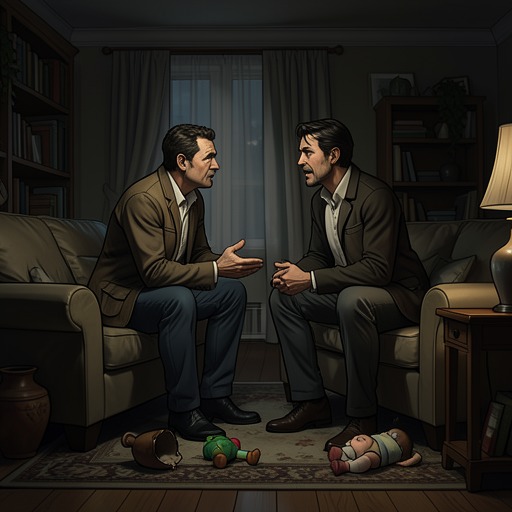
Christian Habersaat and June Kofoed
The Hanging GirlChristian Habersaat and June Kofoed’s marriage is defined by a widening divide between family life and Christian’s fixation on the Alberte case. The rupture is visible both in Christian’s recollection of the home they shared and in June’s later refusal to revisit their history: for him, the case permanently marks the loss of his wife and son; for her, his devotion to it explains the husband and father she believes abandoned them.
Domestic Life and Its Rupture
Christian’s memories locate the marriage’s collapse inside an ordinary family home. In the living room, he remembers making love with June on the sofa; on the rug, he remembers crawling about with their son when the boy was very small. The same rooms hold the beginning of their arguments and the deepening of Christian’s gloom. Domestic intimacy and marital breakdown occupy the same physical space: the home preserves not a single settled account of the marriage but the sequence from closeness to conflict.
The decisive separation comes in that living room. Christian remembers June spitting in his face before leaving him alone in life, an act that fixes the end of the marriage in his memory as both personal rejection and consequence. He understands why things had gone as they did, but understanding does not bring the family back. Looking at a worn photograph, he longs for the wasted days to be restored and for one last experience of closeness with his wife and boy. The photograph and the remembered rooms make the loss concrete; his regret is directed not only at separation, but at the nature and decisions he believes helped bring it about.
The Case Against the Marriage
Christian’s own account ties the family’s unhappiness to his inability to let the Alberte case go. Its effect, as he remembers it, was immediate and lasting: it knocked him down and left him in an almost permanent state of dejection. He continued pursuing it despite the damage it did to his life, regarding that persistence as something he could not change and had good reason to maintain. His attachment to the case therefore stands in direct tension with his wish to recover family closeness. He can recognize the cost, but recognition does not mean he relinquishes the pursuit.
June describes the same history from the other side of that tension. In a later telephone conversation with Carl Mørck, she says Christian did not choose his family during difficult years when she—and especially their son—needed his attention. She rejects the idea that Christian’s death entitles anyone to reopen their mutual problems, and characterizes his suicide as cowardly. Her account presents the case not as a private interest with consequences at the margins of family life, but as the passion that displaced the attention she and their son needed. Where Christian’s recollection emphasizes his inability to let go, June emphasizes what that inability withheld from his family.
June’s Rejection of the Past
June’s distance from Christian is expressed not just in what she says, but in how thoroughly she has put the marriage behind her. She has discarded his name and other things that might bring back memories, and does not conceal this when Carl attempts to speak with her. Her refusal is active: she will not serve as a source for an account of Christian’s life or reopen the problems they shared. The rejection extends beyond his memory as a person to the materials and conversations through which that memory might be recovered.
When June later meets Carl Mørck, Assad, and Rose, her response remains sharply divided. She says that she and her son had a good life without Christian and dismisses their son as complicated, correcting herself from the past tense when she recognizes that he is dead. The correction exposes the son’s absence even as she insists on the family’s life without his father. She then says Christian was obsessed with Alberte: from the day he found her body, he no longer existed in their world, becoming loathsome, spiteful, and creepy in her eyes. Her description makes the case the point at which, for her, Christian ceased to belong to the family.
Two Accounts of Loss
The marriage is presented through a contrast rather than a reconciliation. Christian’s memories dwell on shared affection, regret, and the wish to change his decisions; June’s testimony dwells on unmet need, estrangement, and her refusal to carry his story forward. His image of the family is a lost closeness he still longs for, while hers is a life she says continued without him. Neither account erases the other: the remembered sofa and rug establish real intimacy, but they do not undo June’s account of the years when she and their son needed him.
That tension gives the marriage its significance in the Alberte case. Christian’s pursuit is not merely the work that occupies his attention; it is the force that his family associates with his withdrawal and the collapse of their shared life. June’s refusal to discuss him, set against his lingering attachment to the family he lost, shows how differently the same history survives for the two of them. The case remains central to Christian even after his death, while June’s stated boundary is that his passion and their mutual problems should no longer be hers to explain.